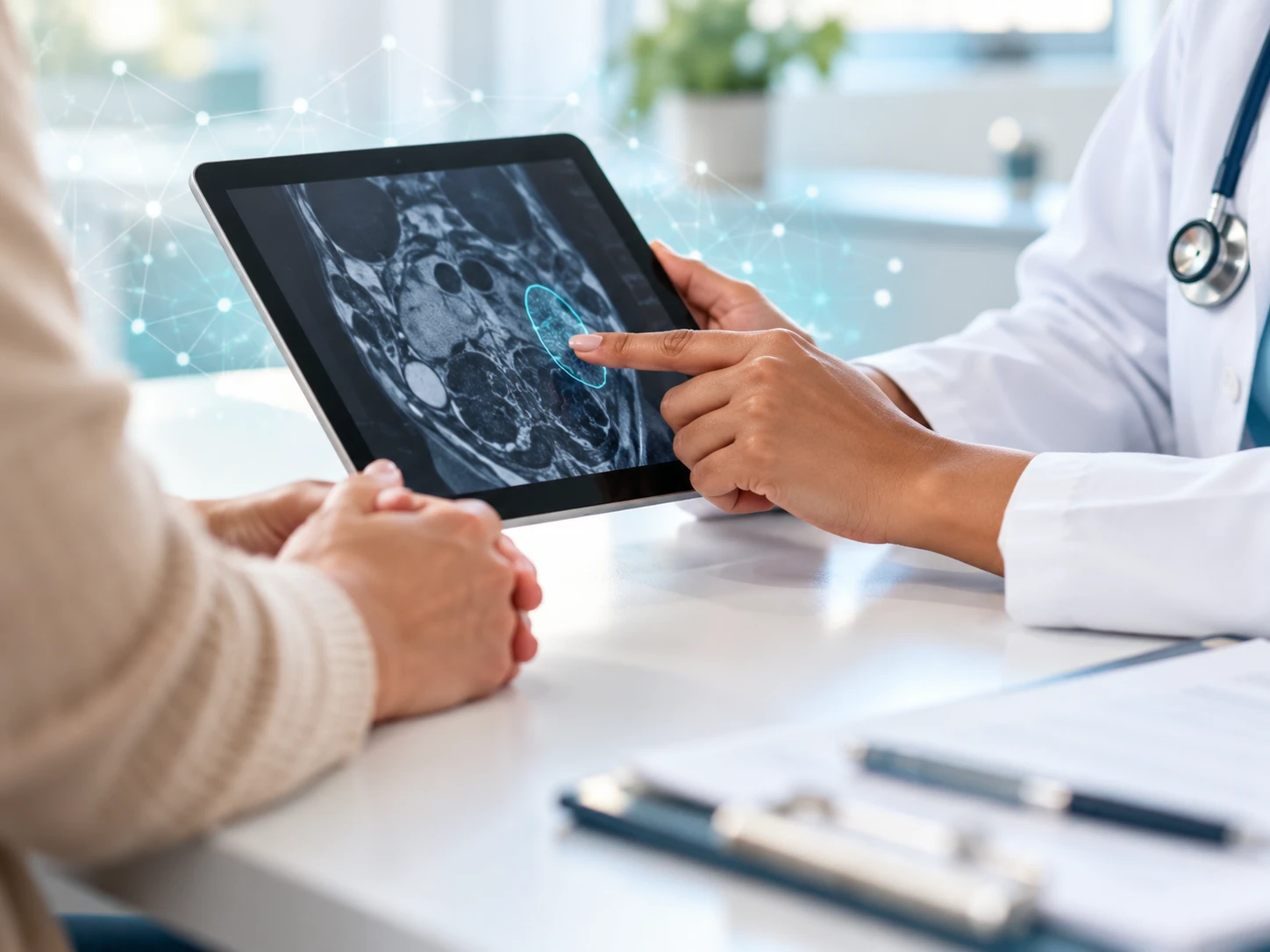
I am asked about artificial intelligence in medicine more often than about almost anything else now, by patients, by companies building products, and by the people funding them. The question usually arrives in one of two moods: hope that the machine will finally fix a system that feels broken, or fear that it will replace the judgment people rely on. Both moods miss the useful question, which is narrower and more practical: where, specifically, does AI help a patient today, and where does it only appear to?
I have spent my career between the laboratory and the clinic, and I have watched several technologies arrive with the same promise. The honest map looks like this.
Start with the problem, not the tool
A technology helps a patient when it changes a decision or an outcome for the better. It does not help when it produces something impressive that nobody acts on, or that someone acts on wrongly. So the first thing I do with any AI claim is to ask what decision it touches. Reading an image? Prioritising a queue? Drafting a letter? Suggesting a diagnosis? Each of those is a different problem with a different tolerance for error, and the same model can be excellent at one and dangerous at another.
The question is never “is the AI good?” It is “good at what, for whom, and what happens when it is wrong?”
Where it already helps
- Pattern recognition with a human still in the chair. In imaging, pathology, and some areas of screening, models can be a tireless second reader. They flag what a clinician should look at twice. Used that way, as a prompt rather than a verdict, they add real safety.
- The administrative burden. Much of what exhausts clinicians is documentation, coding, scheduling, and correspondence. Tools that draft notes, summarise long records, and handle the paperwork give time back to the consultation. That is not glamorous, and it is one of the most important things AI does for patients, because an unhurried clinician is a better one.
- Making records legible. A person with a complex, cross-border history often carries years of reports in several languages and formats. Organising and summarising that material so the right facts are in front of the right specialist is work that AI accelerates well, provided a human checks the summary against the source.
- Explaining, in plain words. Patients routinely leave appointments without understanding what was said. Well-designed tools that translate a plan into clear language, at the reader’s level and in their language, close a gap that has existed for as long as medicine has.
- Monitoring between visits. Wearables and at-home diagnostics, with software that notices a trend, can turn a yearly snapshot into a continuous picture. For hormonal, metabolic, and reproductive health in particular, this is beginning to matter.
Where it does not, yet
- Judgment under uncertainty. Medicine is full of decisions where the evidence is incomplete, the patient’s values matter as much as the data, and two reasonable clinicians would choose differently. A model can lay out options. It cannot own the decision, and it should not be presented as if it can.
- The history. Most diagnoses still come from a careful conversation. The symptom the patient mentions on the way out of the door, the detail they were embarrassed to type into a form, the thing their mother also had: these do not live in structured data, and the tools that depend on structured data miss them.
- People the data forgot. Models learn from the records they are given, and those records over-represent some populations and under-represent others. A tool that performs beautifully in one setting can perform poorly for the very people who already receive the least attention. In my own fields, that gap is not theoretical.
- Accountability. When a recommendation is wrong, someone has to answer for it. Until it is clear who, the appropriate role of the tool is to inform a professional who remains responsible.
- The consumer layer. Apps that promise to diagnose from a photo or a questionnaire, or to replace a consultation altogether, sit at the far end of the risk curve. Some are useful for awareness. Few are substitutes for care, whatever the marketing says.
Three questions to ask
Whether you are a patient offered an AI-assisted service, a company building one, or an investor evaluating one, the same three questions do most of the work.
- What decision does it change, and what is the cost of being wrong? A tool that reorders a waiting list has a different burden of proof from one that suggests stopping a medicine.
- Who was it tested on, and does that include people like the ones who will use it? Ask for the populations, not the headline accuracy.
- Who remains responsible? If the answer is nobody, the product is not ready, however good the demonstration.
What this means for the people we work with
For individuals and families, the practical advice is simple: welcome the tools that make your care clearer and your records more usable, and keep a human expert who is on your side between you and anything that makes a recommendation. For companies and the investors behind them, scientific credibility is the scarcest input in this market, and it is built by being precise about what a product does and does not do. For institutions, the opportunity is in the unglamorous layers, documentation, navigation, and monitoring, where the gains are real and the risks are manageable.
AI will improve care. It already does, in specific places, for specific tasks. The work is to be exact about which ones, and honest about the rest.
This article is for education and discussion. It is not medical advice and does not create a clinician-patient relationship. Carapuse Bay provides non-clinical advisory and advocacy; personal medical decisions belong with your own licensed treating providers.